




page content
Skip page content11-Month-Old Infant Returns Home for Passover After Complex Infection
After a severe infection spread near her brain, the infant underwent intensive care and surgery. Now stable, she continues treatment at home under a full medical supervision program
Date: 05.04.26 | Update: 13.04.26
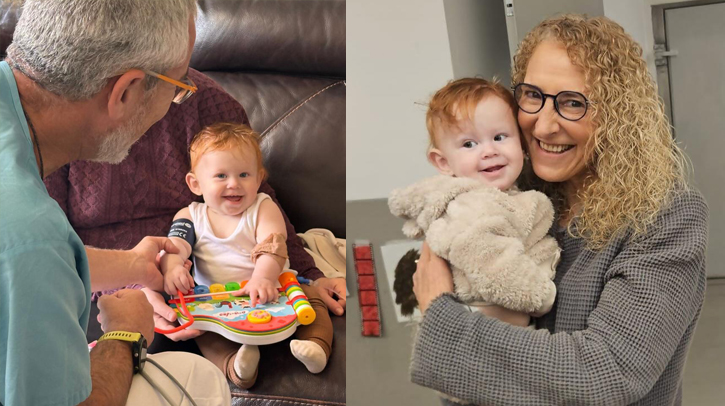
Shiri, an 11-month-old infant from Pardes Katz, is now back home with her family in time for Passover, following a complex infection that required intensive treatment at Schneider Children’s Medical Center of Israel, part of the Clalit group. Her discharge was made possible through Schneider Children’s "Hospital at Home" program, which resumed activity following the war.
She was admitted with what initially appeared to be a routine ear infection that developed into an abscess. Her condition deteriorated, and she was transferred to the Pediatric Intensive Care Unit with a severe infection, where she underwent drainage of the abscess and received intensive treatment.
After an initial discharge, Shiri’s condition worsened, and she returned to the hospital with her parents. Further evaluation revealed that the infection had spread to the area surrounding the brain, requiring an additional surgical procedure. Following the operation, she was admitted to Pediatric Department A in the hospital’s fortified complex, where she remained under close monitoring and treatment for several weeks, until a significant improvement in her condition.
Now stable and requiring only continued antibiotic therapy, Shiri has been discharged home through the Hospital at Home program. She will be able to spend the Passover holiday with her family while continuing to receive full medical care from the hospital’s specialists.
“We went through a very difficult time, with a lot of fear and uncertainty,” said Rachel, Shiri’s mother. “Seeing her improve and knowing we can be together at home for the holiday is very emotional for us. It truly feels like a sense of freedom. We also feel safe at home thanks to the team’s support.”
Prof. Gilat Livni, Director of the Department of Pediatrics “A” at Schneider Children’s Medical Center of Israel, said: “This is a known complication of ear infections in children, typically treated with hospitalization and intravenous antibiotics. In most cases, children are discharged within a few days. In Shiri’s case, the condition was more severe, as fluid had accumulated around the brain tissue. When her condition did not improve, surgical intervention was necessary in order to drain the fluid, clean the area, and send cultures to rule out additional bacterial involvement. During the procedure, the neurosurgical team created a small opening in the skull, drained the fluid surrounding the brain, and irrigated the area. Shiri then continued to receive antibiotic treatment, and her condition gradually improved, ultimately allowing her to continue treatment at home. I led the initial pilot of this program about four years ago, during which approximately one hundred children were treated.”
Dr. Shlomit Yaron, Deputy Director of Schneider Children’s Medical Center of Israel, added: “At a time when the hospital is operating under emergency conditions and demand on fortified areas is high, it is important for us to find solutions that allow us to continue providing high-quality, safe medical care to children. The Hospital at Home model, which we developed several years ago, enables children whose medical condition allows it to receive ongoing treatment and close monitoring within a full professional framework, while remaining in their familiar home environment and avoiding unnecessary exposure to infections. The service has also been expanded to our mental health services, which operate a home hospitalization framework for patients who are psychiatrically stable. For many children, the ability to remain at home with their families instead of being hospitalized is highly significant, and we are glad to be able to continue and expand this service during this challenging period. So far, several children have been discharged home through this program and continue to receive full medical and emotional care."
Yaron Fuchs, a nurse in the program who accompanies the family as part of the ongoing care, said: “Each evening, a physician from the treating department contacts the family for follow-up and consultation. In addition, I visit the home to monitor vital signs, administer medications, manage IV treatments, and provide all necessary care, just as would be done during hospitalization, but in the home setting."

.jpg?BannerID=98 "Important Telephone Numbers")



.jpg?BannerID=97 "International Patients")

.jpg?BannerID=96 "Donate Now")